Denver Botanical Gardens

Denver Botanical Gardens

Sunday, April 3, 2016

Day 3 - To Aldea del Cano, Day 4 To Caceres

Day 3
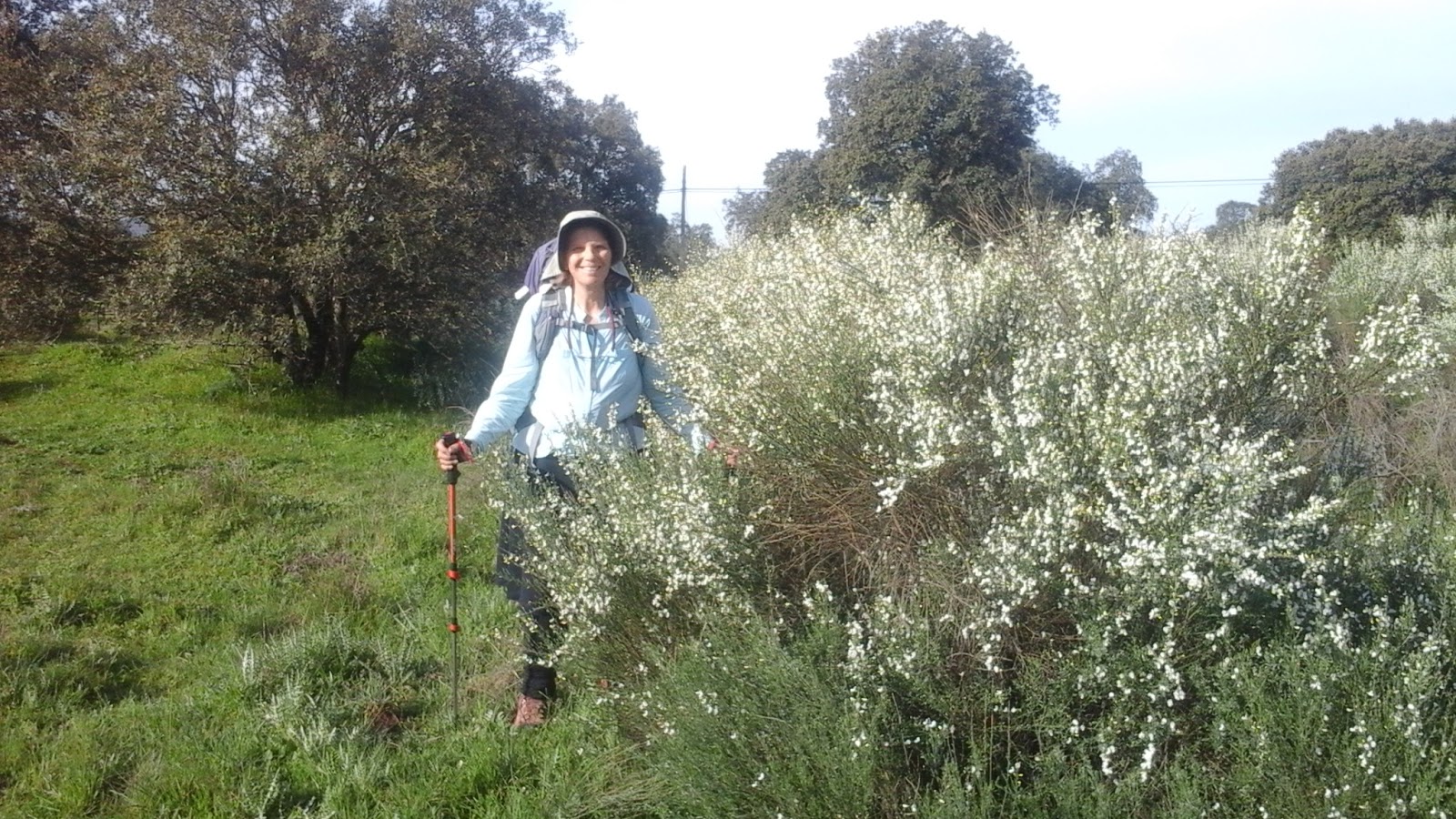
Another fine day.  The lambs were looking at us like we were the first humans they'd seen.  The sight of a stork landing in a grassy field reminded us of pelicans in Colorado, much more graceful than you might think. Several new wildflower species were in bloom.

We passed our first Roman Miliario today. These pillars of stone were set one mile apart along the road which goes north from Merida, as in other parts of the empire. Some have disappeared over the centuries, but many still stand.  Much like our highway milage markers, they were numbered to indicate distance from the origin. I recently learned that the Romans defined the "mile" that we still use in the USA. It was 1000 strides of the average Roman soldier (actually 2000 steps, but only counted as 1000 because they counted only when right foot struck the ground).

Weather: Low 34F High 64F
Quote from RA's journal: "The camino provides so much opportunity to stretch oneself, remain flexible."
Tip for pilgrims: The monastary building in Alcuescar is not heated, be prepared for a cold night if you are not walking mid-summer. The walk to Aldea del Cano is well marked. The bar next to the albergue in Aldea is VERY noisy on Saturday night.

Day 4
This was the first day that was hard. Not terribly long, but morning rain prevented our typical trailside breaks, and our bodies are sore.  The path was mostly in a large right-of-way that seems to be used for moving sheep north and south.

A couple more thoughts on the monastery two days ago.  Our guide for the monastery tour was Cleophus, who is originally from Tanzania. The buildings once housed a school for youths, but demographic changes in the last 50 years result in an assisted living home for the elderly (I wondered if some of the men who are given aid here now might have attended the school several decades ago).  The meal was simple, but adequate.  I was disappointed we did not eat with the men who are being cared for, but we were directed to a separate dining area,.

Weather: Low 50F High 58F. Rainy morning, breezy afternoon.
Quote from RA's journal: "Remember to find joy in the journey."
Tip for pilgrims: Caceres is big, but not as spread out as Leon or Burgos. Grocery stores closed on Sundays.  We stayed at a hotel to get some good rest.

Men getting afternoon sun in Alcuescar.
Miliario stone.
So many beauties.
Antique olive press?
Dinner selfie with Maria, Hans, and Peter.
Storks make use of the churches
Room with a view in Caceres.

Friday, April 1, 2016

Day 2 - To Alcuescar

Perfection.  If I were to describe the perfect Camino day, this would be it. About 12 miles, mostly on dry dirt track.  A little frost on the backs of the sheep at first light and warm sun for the remainder of the walk. Not a cloud in the sky. The path seemed to be in the "middle of nowhere" with a few cattle and one flock of sheep meeting us mid-morning.  The monestary in town cares for pilgrims who stop by and a number of disabled men who live here.  A tour is offered at 6:00 pm, mass at 7:00, and a community meal at 7:30.  I will need to add details later, as I am writing this before the evening events.

Jose is a Spanish man we've shared quarters with each night so far. We helped each other with language for quite a while last evening. He is doing his eighth Camino.  Very friendly and very good at snoring.

The restaurant where we found good wifi has a nice collection of european elk antlers (Cafe Alejandro). We ordered our first cafe-con-leches of the trip.  We enjoy them but other Americans seem to have a much greater fascination than us.

Weather: Low 32F High 62F Sunny.
Quote from RA's journal: "Lord help me be 'in the moment' and aware of You".
Tips for pilgrims: At the top of the hill, maybe two miles before Alcuescar, take the right hand fork to go toward the town (signs and arrows pointing both left and right), then at the botton of the hill as you get to the edge of town, take the left fork down a grassy alley to go to the monestary, which is on the highway.

Church in Aljucen in the evening sun
Old stone wall
Camino traffic jam
Thousands lined our path
Local wall decor.

Thursday, March 31, 2016

Day 1 - To Aljucen

As we begin a new walk, I (Mike) will be doing most of the writing.  Our first day was a short one.  Just under 10 miles through beautiful ranchland.  Leaving Merida the Camino passes an incredible Roman era aquiduct, and an hour or so later the lake that was built to feed the aquiduct (see pictures below). 

We were able to relax in replica Roman baths in Aljucen.  There is a discount for pilgrims, and massages are also available.  There are three large, candlelit baths with cool, warm, and hot water.  All three are yours, in complete privacy for up to 90 minutes! Seemed like a little too much luxury for our first afternoon on the trail.

Weather: Low 42F High 68F  Windy for most of the day, sunny.
Tip for pilgrims: About 2.5 km past the lake, there is turn off onto a very nice dirt path. The turn is not well marked, but if you find yourself walking east for any distance you have probably missed it.
Line from RA's journal: Wildflowers painted the hillsides in their varied hues, some vibrant, some muted, all beautiful.

Roman Aquiduct
Proserpina Lake
The countryside
Termas Aqua Libera
Albergue Rio Aljucen. Wonderful.

Wednesday, March 30, 2016

Anticipation

"Well," said Pooh, "what I like best," and then he had to stop and think.  Because although Eating Honey was a very good thing to do, there was a moment just before you began to eat it which was better than when you were, but he didn't know what it was called." A. A. Milne in Winnie-the-Pooh
We will begin our walk shorty.  Our journey might not seem much like Eating Honey, but I find the anticipation thrilling.
What will the weather bring?
Who will we meet?
What memorable conversations will take place?
How often will acts of charity be given? Received?
Will our bodies endure?
When will we come across sights which will impress?
So many more questions.  We celebrate the past, live in the moment, and anticipate the future.
The trip over here was good.  We plan to start walking tomorrow after visiting the Seville cathedral on Tuesday and the Roman ruins in Merida on Wednesday. We actually put on several miles finding and touring these sights. Great weather so far. Low 50F High 72, Dry.
Best food of the travel days: TGB Max at the The Good Burger on Martin Villa Street near the Seville cathedral.
Most Difficult:  Didn't take our boots off during the overnight flight, must remember this next time.
Line from R.A.'s journal:  The orange trees around the cathedral had both ripe fruit and blossoms, smelled amazing.
Arrival

The largest altar piece ever made

Painting of St. James from early 1600s
Ampitheater for gladiator "games"
Built by/for Agrippa in 15-16 B.C.

Wednesday, March 23, 2016

The Via De La Plata

Someone has said "You walk the Camino Frances to meet others, you walk the Via de la Plata to meet yourself."

We've been to Spain twice in the fall, and we look forward experiencing it in the spring.  We are eager to see the young lambs and calves, the storks nesting on the church towers, the wildflowers in bloom, the green fields of grain, and so much more.

The most common name of the path we are walking this year is the Via de la Plata.

There are several walking paths that lead to the town of Santiago de Compostela.  Our previous walks in Spain were from east to west, along the Camino Frances. This walk with be from south to north.  The Via de la Plata is a path that dates back to at least Roman times.  A western fork now leads to Santiago.  Several sections of our walk will be on stone roads built by the Romans.  These paths have seen the fall of that empire, followed by several centuries of Muslim society, and then the gradual transition to a Christian culture.  We plan to start in Merida, which dates to Roman times, pass through several towns with names that originated within the Islamic tradition, and visit some of the most spectacular Christian cathedrals in Europe.  This unique blend of history is sure to be fascinating.

The Via de la Plata is one of the lesser traveled paths in Spain. It is likely to seem lonely at times, with longer distances between towns.

We look forward to whatever the road has in store for us, and would love to have you follow along.  You are welcome to post comments, we really enjoyed hearing from family and friends on our preious walk.


A map of the Via de la Plata, with our starting point, Merida, highlighted.

Sunday, March 6, 2016

The last 16 months

We've been absent on the blog for many months, but very active in our real lives.  We still walk/hike regularly. Our new friends Jim and Jeanette invited us to join a Tuesday morning hiking group which we have enjoyed.  Along with the two of them and 8 others, we walked a 115 mile pilgrimage to Chimayo, New Mexico in September 2015. Our family has added a 4th grandchild, and we continue to be active in our hobbies of gardening, fishing, and other outdoor activities. The commitment we have to our church has been rewarding as we share the Gospel with each other and our community.  You are welcome to join us as we reactivate the blog and share our Via de la Plata plans and experiences.

                            This is our group in front of the church in Chimayo, Sept. 27, 2015

Wesley

Thursday, November 20, 2014

The food of the Camino

"Don't need no five star reservation. I got spaghetti and a cheap bottle of wine...."  Darrius Rucker - Alright.
We've mentioned food a few times on this blog and posted a few pictures.  We hope a little more detail will be valuable to some readers.
Pilgrims find all sorts of ways of managing food along the path.  Some choose to eat at the little cafes for nearly every meal.  Four euros for breakfast, six for lunch, and ten for dinner.  For two people this would be over $50 per day at current exchange rates.  This might be fine for a short trip, but for a 7 week adventure, it just doesn't work for us.
We ate out when we needed to, and after a particularly difficult day, we found it quite comforting to let someone else take care of us.  Most days we found a "supermercado", investigated what was on the shelves, and invented a recipe with the available choices.  Many of the albergues have kitchens the pilgrims can use.  Sometimes a meal with no cooking was required.  For breakfast and lunch we made bread, cheese, various fruits, tuna, olives, chocolate, nuts and such some of our staples.  We also often bought eggs to boil in the evening.  In cool weather these will last for at least 36 hours, and make a great high protien snack.
One of our favorite types of refuge is the Parochiol Albergue.  In many of these, all pilgrims eat together at a large table for the evening meal.  Some of the hosts appreciate help in the preparation, others handle it themselves.
Like many other aspects of the Camino, we learned to simplify our expections, and be thankful for any neccesity we found.  It has given us new appreciation for the Lord's prayer phrase "give us this day our daily bread".  We know much of the world's population is much more in tune with this concern than we normally are.
Here are a few pictures of our meals from our journey.
Charizo and Potato soup provided by our hosts in Logrono.
Lunch in a streetside park in Navarrete.
They call it "tortilla" in Spain.  It is a wonderful egg and potato dish that was our favorite when we did buy breakfast.
Best thing about this dinner was the new friends we shared it with.
Our own egg and potato concoction for supper
A surprisingly good dinner of ham sandwiches and microwave veggies.
One of the few dinners we purchased at an albergue, good but unremarkable.
Early Thanksgiving Dinner in Moratinos.
Enough to share with two fellow pilgrims.
No wine, but I did have the woman I love to share it with.